
By Karen Richardson, Star Property Partners · Figures checked: 28 October 2026 · This guide is about buying in Bath, England
Yes, you can buy a home in Bath from Hong Kong. It follows the same English process as any other purchase: find a property, make an offer, instruct a solicitor, exchange contracts and complete. For overseas families there are a few extras: identity and source-of-funds checks, an additional Stamp Duty surcharge, finance from overseas, and the need for someone local to see the property for you. GOV.UK says buying a home takes about five months on average, so it is worth starting to prepare earlier than you might expect.
I live near Bath and I'm a mum myself, so I know the questions that keep a parent awake when their child is thousands of miles away. This guide walks you through the process step by step, explains what is different when you are buying from Hong Kong, and helps you decide whether buying is worth exploring at all.
I'm not a solicitor, tax adviser or mortgage adviser, so I point you to official sources throughout and explain where you will need a professional.
英國買樓流程:簡要摘要
香港家長可以在海外為就讀巴斯大學(University of Bath)的子女購買巴斯的物業。英國買樓流程大致包括:準備資金及身份核實、(如需貸款)與按揭顧問溝通、聘請律師、睇樓、出價、律師辦理查冊及合約、交換合約,最後完成交易。根據英國政府資料,在英國買樓平均需時約五個月。非英國居民在英格蘭購買住宅物業,一般須額外繳付 2 個百分點的印花稅(SDLT)附加費;如名下已擁有其他住宅物業,亦可能須繳付較高稅率。實際稅項視乎個人情況,請向專業人士查詢。
Should you buy or rent for your child in Bath?
Renting is simpler and more flexible. Buying can make sense if your child will be in Bath for several years and your family is comfortable owning UK property for longer than the course. Neither is automatically cheaper, and I would never want you to buy just because it sounds like a good idea.
Here is how the two compare at a high level:
- Money needed up front: Renting – A deposit of up to 5 weeks' rent if the annual rent is under £50,000 (6 weeks if £50,000 or more), a holding deposit of up to 1 week's rent, and after signing up to one month's rent (28 days if rent isn't paid monthly) before the tenancy starts; Buying – The purchase price (from savings, or a deposit plus a mortgage), Stamp Duty Land Tax, legal fees, searches and any survey
- Type of agreement: Renting – Most new private tenancies in England are assured periodic tenancies, which have no fixed end date. University halls usually use a different agreement; Buying – You own the property, so you decide how long to keep it, subject to any mortgage
- Responsibility: Renting – The landlord owns the property; Buying – Your family owns it, with the costs and responsibilities that come with that
- After graduation: Renting – The agreement ends according to its terms; Buying – You still own it. You could sell, let it, or keep it for a younger sibling
- Main risk: Renting – Rent keeps going out, and nothing is left at the end; Buying – Property values can fall as well as rise, and there is no guarantee that buying works out better than renting
Since 1 May 2026, for most new private tenancies in England, a landlord or agent can't ask for rent before the agreement is signed. After signing, they can usually ask for no more than one month's rent before the tenancy starts. I explain the rules in my guide to arranging Bath accommodation from Hong Kong, and the full costs of renting and University accommodation are in my University of Bath accommodation costs guide.
If you are still weighing up all your housing options, start with my Hong Kong parent's guide to where your child could live in Bath. Renting first can give your child time to settle in and work out what suits them.
How does buying a home in England work? Step by step
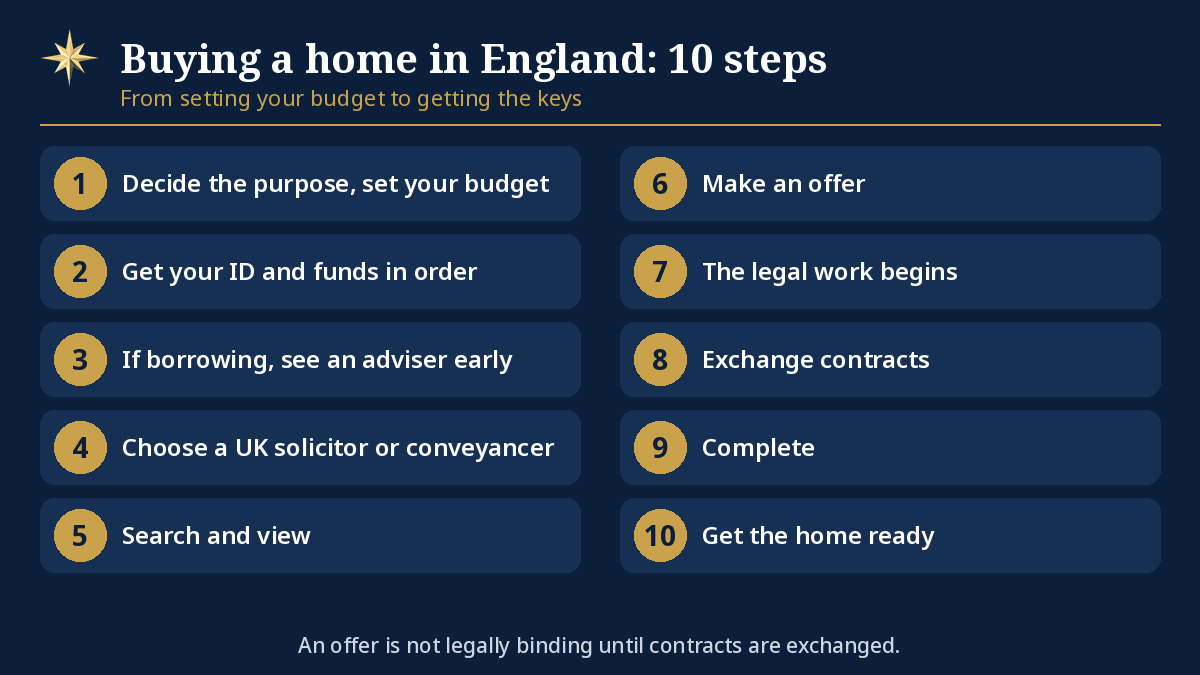
There are ten practical steps, from setting your budget to getting the keys. An offer is not legally binding on either side until contracts are exchanged. Here is how it usually runs:
- Decide what the property is for, and set your budget. Is it simply your child's home, or do you also want it to work as a longer-term investment? Will friends live there? Will you pay cash or borrow? Add the costs of buying, not only the price. I'd talk to your tax and legal advisers at this stage.
- Get your ID and funds in order. You will be asked to prove who you are and where the money comes from. Having your documents ready avoids delays later (more on this below).
- If you need a mortgage, speak to an adviser early. Your lender has to confirm the mortgage before you can exchange contracts.
- Choose a UK solicitor or conveyancer. GOV.UK says the legal work can be done by a solicitor, licensed conveyancer or CILEX practitioner. Ask them how documents are signed and identity is checked for clients living overseas.
- Search and view. This is where having someone local makes a real difference. Photographs can't tell you what the road is like, what is next door or how far the "short walk" really is.
- Make an offer. This is usually done through the estate agent. An offer "subject to contract" can still be negotiated, for example if a survey finds a problem.
- The legal work begins. Once your offer is accepted, your solicitor or conveyancer arranges searches (usually local authority, water and drainage, and environmental). The seller's solicitor drafts the contract. Your lender will value the property if you are borrowing, and you can choose to have a survey.
- Exchange contracts. Both sides sign and swap the final contracts, and the sale becomes legally binding. If you pull out after this, you may lose your deposit. You need buildings insurance in place from exchange, and you agree the completion date.
- Complete. Your solicitor transfers the money to the seller, you receive the legal documents to transfer ownership and the keys, and the property is yours. A Stamp Duty return and payment must go to HMRC within 14 days of completion. Your solicitor usually does this for you and adds the tax to their bill.
- Get the home ready. Arrange keys, a clean, any repairs and furniture before your child arrives. Applying for the Council Tax student exemption belongs here too.
If you'd like help picturing how this could work for your family, you can book a 30-minute introductory call with me.
How long does it take? A realistic timeline
GOV.UK says buying a home takes about five months on average, and it can take longer if you are part of a chain. GOV.UK doesn't say exactly where it starts counting, so I'd allow extra time for finding the right property and getting your funds and paperwork ready.
- Prepare: What happens – Budget, ID and funds, mortgage adviser if borrowing, choose a solicitor; Timing – Varies. Do this before you start looking
- Search and view: What happens – Shortlist, viewings (including video or someone local), questions to the agent; Timing – Varies with the market and how specific your brief is
- Offer to exchange: What happens – Offer accepted, searches, survey and valuation, contract enquiries, mortgage confirmed; Timing – The bulk of the process. GOV.UK's average for the whole purchase is about five months
- Exchange to completion: What happens – Contracts legally binding, buildings insurance in place, completion date agreed; Timing – Often around 2 to 4 weeks, though exchange and completion can happen together
- After completion: What happens – Stamp Duty return and payment (14 days), keys, clean and repairs, furnishing, Council Tax exemption; Timing – Plan this before completion, not after
I can't promise a timescale for any particular purchase, because chains, surveys and lenders all affect it. My suggestion is to begin preparing well before the academic year you are aiming for. That is my advice, not an official figure.
What is different when you buy from Hong Kong?
Overseas buyers follow the same legal process, with additional checks, an extra tax and a bigger need for local help. These are the four things I'd look at first.
Identity and source-of-funds checks
Estate agents in the UK have to carry out money-laundering checks on buyers as well as sellers. HMRC's guidance says the identity checks must be completed by the time your offer is accepted, and recommends completing the wider checks, including the purpose of the purchase and where the money comes from, before then. Your solicitor or conveyancer will also have their own checks, so ask them what they will need. Expect to provide proof of identity and evidence of where your funds came from, and give yourself time to gather it.
Stamp Duty Land Tax (SDLT): the extra costs for overseas buyers
If you are not present in the UK for at least 183 days in the 12 months before you buy, you are "non-UK resident" for Stamp Duty purposes and usually pay a 2 percentage point surcharge on top of the other rates. Nationality, citizenship and visa status don't matter for this test. If you buy with someone else and any one of you is non-UK resident, all buyers are treated as non-resident (with a limited exception for married couples and civil partners, so check your own position).
If you will own another residential property anywhere in the world after the purchase, for example your home in Hong Kong, you will usually also pay the higher rates for additional properties, which are 5 percentage points above the standard rates. The surcharge for non-residents is added on top of those.
These are the England rates for purchases from 1 April 2025, as shown on GOV.UK on 28 October 2026:
- Up to £125,000: Standard rate – 0%; Higher rate for an additional property – 5%; If you are non-UK resident – Add 2 percentage points to each rate
- £125,001 to £250,000: Standard rate – 2%; Higher rate for an additional property – 7%; If you are non-UK resident – Add 2 percentage points to each rate
- £250,001 to £925,000: Standard rate – 5%; Higher rate for an additional property – 10%; If you are non-UK resident – Add 2 percentage points to each rate
- £925,001 to £1.5 million: Standard rate – 10%; Higher rate for an additional property – 15%; If you are non-UK resident – Add 2 percentage points to each rate
- Above £1.5 million: Standard rate – 12%; Higher rate for an additional property – 17%; If you are non-UK resident – Add 2 percentage points to each rate
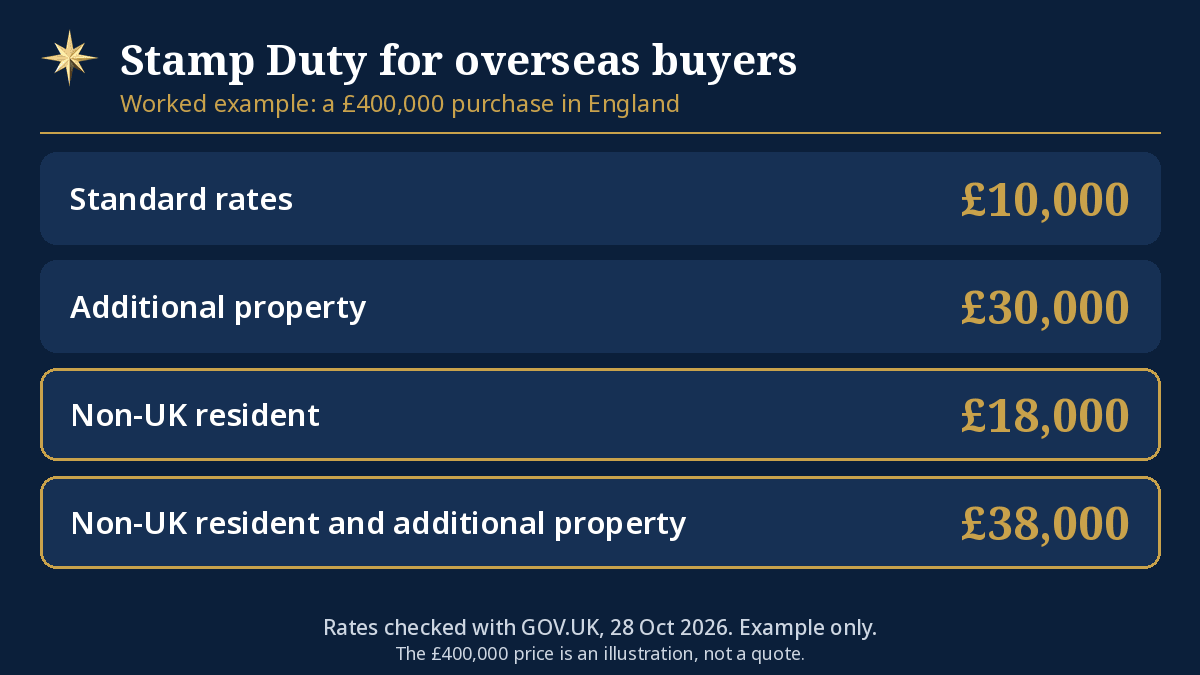
A worked example, for illustration only. The £400,000 price below is not a Bath average, a valuation or a quote. I have used the published rates and the same method as HMRC's own examples.
- Non-UK resident, no other residential property: £2,500 + £5,000 + £10,500 = £18,000
- Non-UK resident, and owns another residential property: £8,750 + £11,250 + £18,000 = £38,000
Checked with GOV.UK rates on 28 October 2026. For your own figure, use the official GOV.UK Stamp Duty Land Tax calculator or ask your solicitor. Rates can change at a Budget, and GOV.UK's non-resident page was last updated on 1 April 2025, so check again before you buy.
First-time buyers' relief takes the first £300,000 to 0% and charges 5% on the portion from £300,001 to £500,000, with no relief above £500,000. But every buyer must be a first-time buyer who intends to occupy the property as their own only or main residence, and it can't be claimed where the higher rates apply. Because it is about the buyer's own home, I wouldn't assume it applies to parents buying for a child, so please ask your tax adviser.
In some cases, individuals who pay the non-resident surcharge can claim it back if they later spend enough time in the UK within a set period. If that could apply to you, your adviser can explain.
Borrowing from overseas
Whether you can borrow, how much and on what terms depends on the lender and your circumstances, so speak to a mortgage adviser who works with overseas buyers before you start looking. I don't quote rates or say which lenders will lend because that changes constantly and it isn't my area. Check that any adviser is authorised on the FCA Register. If you are borrowing, your lender will also value the property and must confirm the mortgage before you can exchange contracts.
Whose name should the property be in?
This needs advice before you decide. In England and Wales, if a property is transferred to a child under 18 on their own, the legal ownership doesn't pass to them; it is held on trust for them. For the Stamp Duty higher-rates test, property owned on behalf of a child under 18 counts as owned by the parents. If your child is 18 or over, owning the property themselves has different legal and tax consequences from you owning it. Please ask a UK solicitor, and a tax adviser who understands both the UK and Hong Kong position, before choosing.
Council Tax, and tax if the property is let
GOV.UK says households where everyone is a full-time student do not have to pay Council Tax, but you must apply. If someone who isn't a full-time student lives there, a bill may be due, with a possible discount.
If you live abroad and the property earns rent, for example if friends of your child pay rent, GOV.UK says UK tax is due on rental income and you may be classed as a non-resident landlord, with rules about how the tax is collected and reported. Whether that applies to you is a question for a tax adviser.
Which parts of Bath suit University of Bath students?
There isn't one best area. I would choose by how your child will get to the Claverton Down campus and how they want to live, then look at the property. The University of Bath's campus is at Claverton Down. Bath Spa University is a different university in a different part of the city, so check that any route you look at goes to the right one.
The table uses the University of Bath's and First West of England's published information, checked on 28 October 2026. I haven't included journey times, because they vary by time of day and address. Use the First Bus app or timetables for the exact address.
- City centre: How buses link it to campus – The U1 and U3 serve the city centre (the U1 stops at Grand Parade and Bathwick Hill on its way to campus). The U1 runs all year; What I'd weigh up – Some students love being able to walk into town. Remember the campus is reached by bus
- Widcombe: How buses link it to campus – The Big Lemon service 20 stops at Widcombe Hill (hourly, Monday to Saturday, according to the University); What I'd weigh up – Close to both the city centre and the University, but that popularity can show in the price
- Bathwick: How buses link it to campus – Bathwick Hill is a stop on the U1, U1N, U2, U3 and U6 routes; What I'd weigh up – More than one route may be available, so check which stop is closest to the property
- Oldfield Park: How buses link it to campus – The U2 runs directly between Oldfield Park and campus (term time only). The U3 and service 20 also serve Oldfield Park; What I'd weigh up – One of the best-known student areas, with shops, cafés and buses
- Combe Down: How buses link it to campus – Check the route and timetable for the specific address; What I'd weigh up – A village on the south-east edge of Bath, about two miles from the Claverton Down campus according to the University's area guide. Mainly terraced and semi-detached houses, many with gardens, and small local shops on The Avenue and Bradford Road
The U1, U3 and U4 run all year. The U2, U5 and U6 run in term time only. For other neighbourhoods, including Southdown, Twerton and Bear Flat, see my guide to where students live in Bath.
Looking at buying rather than renting, I also ask a second question: who else might want to live here later? That affects how easy it could be to let or sell after graduation, and it is why I think about the property and the family at the same time.
What if your child's friends will live there too?
Possibly, but decide before you buy, not after. Bath and North East Somerset Council says an HMO licence is needed if a property is occupied by five or more people who form more than one household and share a toilet, bathroom or kitchen. In the city of Bath, and for some properties around it, you also need planning permission to convert a single-family home into an HMO, and the council notes that an HMO licence does not confirm planning permission. The council has an Article 4 Direction for HMOs in Bath. I cover this in more detail in my Hong Kong parent's guide, so I won't repeat it here.
What do we cover on an introductory call?
It is a relaxed 30-minute conversation about your family's plans, with no pressure to decide anything. There is no obligation, and sometimes the honest conclusion is that renting makes more sense.
On the call we can talk about:
- when your child expects to start at the University of Bath, and your timescale
- whether you are thinking about buying, renting or both
- what you are hoping to find, and whether friends might live there
- how Bath's areas could work for your child
- what you might want to do with the property after graduation
- what you would need to have in place before a search begins, such as advisers, documents and funds
- how local help could work, from viewings and photographs to coordinating the professionals, which you can read about on my Buying a Home in Bath page
I can't give legal, tax or mortgage advice, but I can help you understand which questions to take to the right professionals.
Frequently asked questions
Can a Hong Kong family buy a house in Bath?
Yes. Non-UK residents can buy residential property in England. The main official difference I found is tax: if you are not present in the UK for at least 183 days in the 12 months before you buy, a 2 percentage point Stamp Duty Land Tax surcharge applies on top of the other residential rates. You will also need a UK solicitor or conveyancer and must pass identity and source-of-funds checks.
How long does it take to buy a home in Bath from Hong Kong?
GOV.UK says buying a home takes about five months on average, and longer if you are in a chain. After contracts are exchanged, completion is often around two to four weeks later, though the two can happen together. Finding the right property comes on top of that, so I suggest starting your preparation well before the academic year you are aiming for.
How much extra Stamp Duty do Hong Kong buyers pay in England?
If you are non-UK resident for Stamp Duty purposes, the surcharge is 2 percentage points on every band of the residential rates. If you will also own another residential property anywhere in the world, the higher rates for additional dwellings add a further 5 percentage points. The exact amount depends on the price and your circumstances, so ask your solicitor or a tax adviser to calculate it before you commit.
Can I get a UK mortgage while living in Hong Kong?
It depends on the lender and your circumstances. I can't tell you who will lend or on what terms, and I don't quote rates because they change. Speak early to a mortgage adviser authorised by the Financial Conduct Authority (you can check the FCA Register) who works with overseas buyers, and remember your lender must confirm the mortgage before you can exchange contracts.
Can I buy the property in my child's name?
It needs advice before you decide. In England and Wales, a child under 18 cannot hold the legal title to land on their own; it is held on trust instead. For the Stamp Duty higher-rates test, property owned on behalf of a child under 18 counts as owned by the parents. If your child is 18 or over, ownership has different legal and tax consequences from you owning it, so speak to a UK solicitor and a tax adviser.
Is buying cheaper than renting for a university student in Bath?
Not automatically. Buying means a purchase price, Stamp Duty, legal and survey costs, and the responsibilities of ownership, and property values can fall as well as rise. Renting is simpler and more flexible. Buying may suit a family whose child will be in Bath for several years and who are comfortable owning UK property afterwards. Compare your own numbers rather than assuming either way.
Can my child's friends live with them in a property we buy?
Possibly, but check before you choose the property. In Bath and North East Somerset, an HMO licence is needed where five or more people from more than one household share facilities, and in the city of Bath you may also need planning permission to turn a single-family home into an HMO. A licence does not confirm planning permission, so take advice first.
Will my child have to pay Council Tax on a home we buy?
GOV.UK says households where everyone is a full-time student do not have to pay Council Tax, but you need to apply for the exemption. If anyone who isn't a full-time student lives there, a bill may be due, with a possible discount. Check the position for your household with Bath and North East Somerset Council.
Important information
This guide is intended as general information only and does not constitute investment, financial, mortgage, legal or tax advice. Property values and rental income can rise or fall, and property ownership involves costs and risks.
UK taxation, Stamp Duty Land Tax, overseas purchaser rules, mortgage requirements, planning rules and property regulations can change, and individual circumstances vary. Obtain independent legal, financial, mortgage and tax advice from appropriately qualified professionals before entering into a property transaction. Star Property Partners is independent of the University of Bath.
Figures checked: 28 October 2026.
Sources
Official pages checked on 28 October 2026.
- GOV.UK, Buying a home: overview
- GOV.UK, Buying a home: making an offer
- GOV.UK, Buying a home: transferring ownership (conveyancing)
- GOV.UK, How to buy a home
- GOV.UK, Stamp Duty Land Tax: residential property rates
- GOV.UK, Stamp Duty Land Tax: overview, thresholds and how to pay
- GOV.UK, Rates of Stamp Duty Land Tax for non-UK residents
- GOV.UK, Higher rates of Stamp Duty Land Tax
- GOV.UK, Stamp Duty Land Tax relief for land or property transactions
- HMRC, Anti-money laundering guidance: estate agent business guidance
- Financial Conduct Authority, FCA Register
- legislation.gov.uk, Trusts of Land and Appointment of Trustees Act 1996, Schedule 1 (minors)
- GOV.UK, Council Tax: discounts for full-time students
- GOV.UK, Council Tax: who has to pay
- GOV.UK, Tax on your UK income if you live abroad: rental income
- GOV.UK, Assured periodic tenancies: rent in advance and deposits
- GOV.UK, Private renting: deposits
- Bath and North East Somerset Council, Apply for an HMO licence
- Bath and North East Somerset Council, Article 4 Directions
- University of Bath, Travelling by bus to the University of Bath
- First West of England, Bath Universities bus services
- University of Bath, Living in different areas of Bath
- Bath's Student Community Partnership, Odd Down and Combe Down