
Yes, you can arrange your child’s Bath accommodation from Hong Kong, but it takes a few careful checks rather than a quick booking. Before you pay anything, make sure you have seen the actual room (ideally on a live video viewing), checked who you are dealing with, understood the type of agreement and worked out how your child will get to campus. I’ve set out each step below so you can make the decision calmly, even from thousands of miles away.
Finding somewhere for your child to live in Bath can feel very different when you are making the decision from Hong Kong.
You can browse photographs, compare rents and look at a map. But the questions that matter most are often harder to answer from a distance. Is the room really suitable? How will your child get to lectures? Who will help if something goes wrong?
The most useful approach is to work through five things before committing: the accommodation itself, the daily journey, the people offering it, the agreement and the arrival arrangements. A clear answer in each area can make the whole decision feel more manageable.
This guide focuses on arranging rented accommodation, particularly a private room, flat or shared house.
Start with how your child wants to live
Before building a shortlist, have a conversation about everyday life.
Would your child prefer a sociable shared home, a quieter room or their own space? Are they comfortable sharing a kitchen and bathroom? Do they want to live with friends, or would booking a room individually suit them better?
Agree a realistic budget together, including anything outside the rent. Our University of Bath accommodation costs guide explains how to compare the full cost. Then separate the essentials from the preferences. A proper desk, a manageable journey and a suitable move-in date may matter more than a particularly attractive kitchen.
If university-managed accommodation is an option, check the University’s current eligibility and application information for your child’s circumstances. Do not assume that arrangements for another student, course or academic year will apply.
For private accommodation, the University of Bath’s private-sector accommodation guide is a useful starting point. It links to Studentpad and explains the support available to students.
For the wider picture of where students live in Bath, see my Hong Kong parent’s guide to where your child could live in Bath.
Look beyond the listing photographs
A photograph can show you what a room looks like. It cannot tell you everything about living there.
Ask for a live video viewing if your family cannot attend in person. Where possible, have your child or someone you trust visit too. A recording can be helpful afterwards, with permission, but a live conversation lets you ask the person showing the property to slow down, open a cupboard or show a different angle.

For a useful viewing, ask to see:
- The actual room being offered, rather than a show room or a similar bedroom.
- The desk, storage and usable floor space with the furniture in place.
- Windows, ventilation and any visible staining, damp or damage.
- Shared kitchens, bathrooms, laundry facilities and communal areas.
- The entrance, access arrangements and immediate surroundings.
Ask which furniture and appliances will remain. If a repair or replacement is promised, request written confirmation of what will be done and when.
A viewing is a practical check, rather than a guarantee that there are no hidden problems. If something raises a concern, ask for further evidence or appropriate professional advice before proceeding.
Check the journey to the University of Bath
“Close to the centre” and “convenient for campus” answer different questions.
The University of Bath’s main campus is at Claverton Down. Its walking and cycling guidance notes that routes from the city centre involve a steep uphill climb.
Rather than judging a property by distance alone, work through the likely journey from its front door:
- Where is the nearest suitable bus stop?
- What do current timetables show for the times your child is likely to travel?
- Is a change needed, and how much walking is involved?
- What would the return journey look like after an evening activity?
- Where are the nearest food shops and other everyday essentials?
Use current journey information for the exact address. An agent’s estimated travel time is a starting point to check, especially if it does not explain the route or time of day.
It is also worth asking your child which journey they would actually be happy making regularly. The right answer will vary from one student to another.
Verify who you are dealing with before paying
When an appealing property appears, it can be tempting to move straight to the payment stage. Leave room for checks first.
Find the agent’s or provider’s contact details independently and confirm that the property, person and payment request are genuine. If bank details change, verify the change through an established contact method before sending money.
Be cautious about pressure to pay before a viewing, unusually low prices, or someone who avoids answering straightforward questions. The University’s private-sector guide advises checking that the person offering the accommodation is genuine before paying fees or signing.
A recognised listing platform can help you search, but it should not replace checking the particular property and agreement.
If something feels unclear, pause and ask the University’s accommodation support team for guidance. Losing a little time to a sensible check is preferable to making a commitment you do not understand.
Understand the agreement for this particular accommodation
Student accommodation does not all use the same kind of agreement.
Current GOV.UK guidance for student renters explains that students renting from private landlords are likely to have an assured periodic tenancy. University halls and qualifying private halls usually use a different arrangement, such as a common law tenancy or licence, often for a fixed period.
That distinction affects the questions you need answered. Do not assume that every student rental has a fixed academic-year contract, or that leaving early works the same way everywhere.
Before committing, ask:
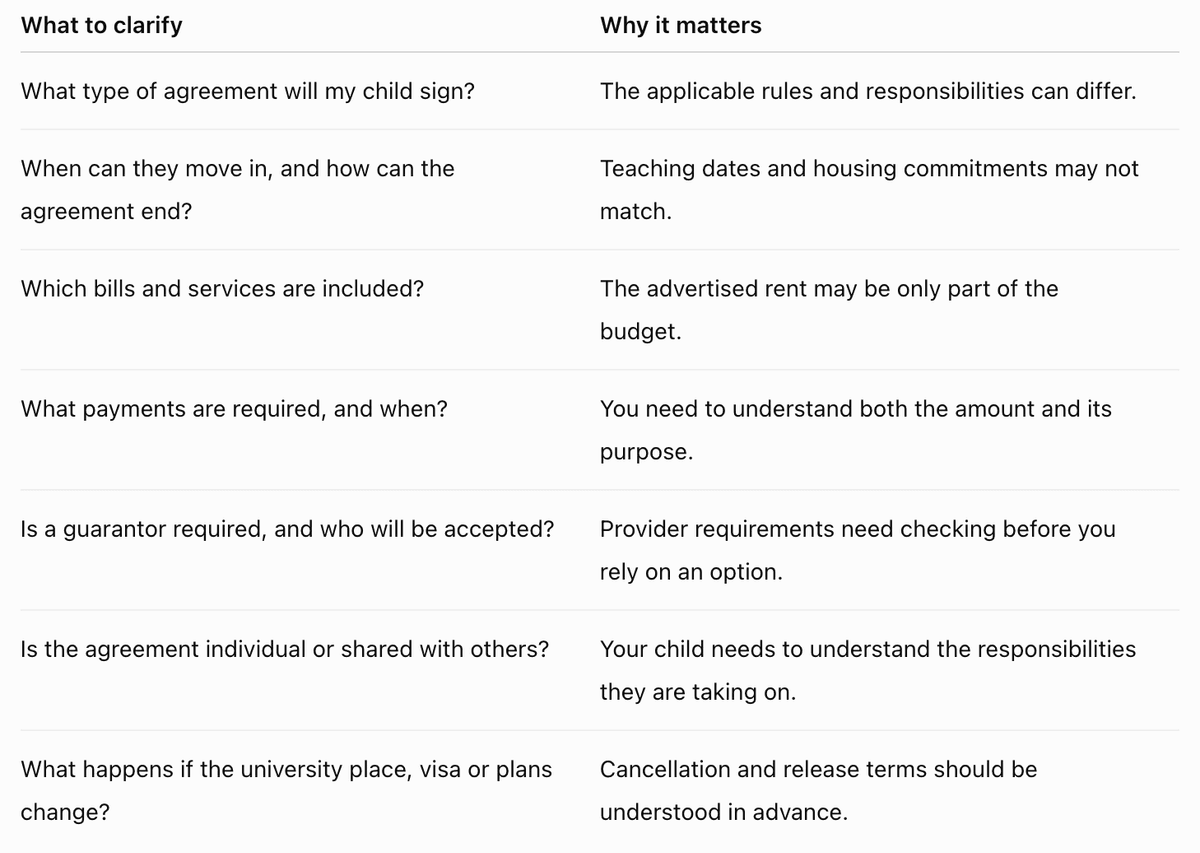
- What type of agreement will my child sign?
- When can they move in, and how can the agreement end?
- Which bills and services are included?
- What payments are required, and when?
- Is a guarantor required, and who will be accepted?
- Is the agreement individual or shared with others?
- What happens if the university place, visa or plans change?
Be particularly careful with advice about paying several months’ rent upfront instead of providing a guarantor. For new assured tenancies in England, since 1 May 2026 landlords cannot ask for rent before the agreement is signed, and they cannot simply require six or twelve months in advance. The government’s rent-in-advance guidance explains the limits, including the usual maximum of one month’s rent (or 28 days’ rent if rent isn’t paid monthly) in the period after signing and before the tenancy starts. Different accommodation arrangements and tenancies signed before 1 May 2026 need checking separately. If your child is considering University halls, check the payment rules with the University.
If you are unsure about a clause or payment request, seek advice on the actual agreement. The University’s private-sector guide lists a free contract-reading service through ResLife; contact the team to confirm access and availability.
Plan the first evening as well as the move-in date
Once the accommodation is agreed, turn your attention to arrival.
Imagine your child reaching Bath with a suitcase after a long journey. What happens next?

Make sure your child has the address, access instructions, accommodation contact and emergency repair number saved somewhere they can reach without relying on a laptop.
At check-in, encourage them to review the inventory, photograph the condition and report discrepancies promptly through the provider’s stated process. Keep copies of the agreement, receipts and important correspondence together.
These are small practical details, but sorting them beforehand can make that first evening much easier.
A final check before you commit
You should be able to explain, in plain language:
What accommodation your child is getting and what has been viewed.
- How they will travel to campus and manage daily life.
- Who is providing the accommodation and receiving payments.
- What the agreement requires and how it can end.
- How your child will get inside and settle in when they arrive.
- Any unanswered question gives you a useful next step. You do not need to know everything about Bath to make a thoughtful decision. You need reliable information about the home your child is actually considering.
Frequently asked questions
Can I arrange my child’s Bath accommodation from Hong Kong?
Yes, it can be done, but a listing and photographs are not enough on their own. Ask for a live video viewing of the actual room, ask someone you trust to visit if you can, check independently that the agent or landlord is genuine before you pay anything, and make sure you understand the agreement before your child signs. The University of Bath’s private-sector accommodation guide is a useful starting point for private options.
Can a landlord ask for several months’ rent upfront?
For most new private tenancies in England, no. Since 1 May 2026, a landlord or letting agent must not ask for, encourage or accept rent before the tenancy agreement has been signed. After signing, they can usually ask for no more than one month’s rent (or 28 days’ rent if rent isn’t paid monthly) before the tenancy starts. If your child is considering University halls, check the payment rules with the University.
How much deposit can a landlord ask for?
For a private tenancy in England, the tenancy deposit is capped at five weeks’ rent where the annual rent is under £50,000, and six weeks’ rent where it is £50,000 or more. A holding deposit, which reserves a property while checks are carried out, is capped at one week’s rent. A tenancy deposit must be protected in a government-approved scheme.
What type of agreement will my child have?
GOV.UK says students who rent from a private landlord are likely to have an assured periodic tenancy, which rolls on and cannot have a fixed end date. Students in university halls or private halls (purpose-built student accommodation) usually have a common law tenancy or licence, often for a fixed period, normally to the end of the academic year. Check which applies before you commit.
If your family is also considering buying
Renting may be the right choice while your child gets to know Bath and works out how they want to live.
If you are also considering buying a home for their university years, I can help you explore the practical property questions and the local support your family would need. My work through Star Property Partners focuses on helping overseas families find, assess and prepare a suitable home in Bath. You can read more about how I work with overseas families on my How we Work page.
You are welcome to explore buying a home in Bath, or book a 30-minute introductory call to talk about your family’s plans, even if buying is still only something you are considering.