
Looking beyond monthly cash flow at the Bath investment case
A few weeks ago, I was talking to a letting agent in Bath and asked a question I've been asking quite a few people recently:
Are you seeing landlords leaving the market?
Given everything we've heard about increasing regulation, taxation and the pressures facing landlords, I expected the answer to be yes.
It wasn't.
He told me that, from what he was seeing, the opposite was true.
More investors were buying.
That conversation stayed with me because I've been spending a lot of time analysing potential investment properties across Bath.
And there was something I couldn't quite reconcile.
The rental demand is clearly there.
The rents are high.
But so are the property prices.
On some of the conventional buy-to-let properties I've been analysing, once I've allowed for mortgage costs, management, maintenance and the other costs of ownership, the monthly cash flow can be relatively modest.
Sometimes only a few hundred pounds a month.
So why are investors still buying?
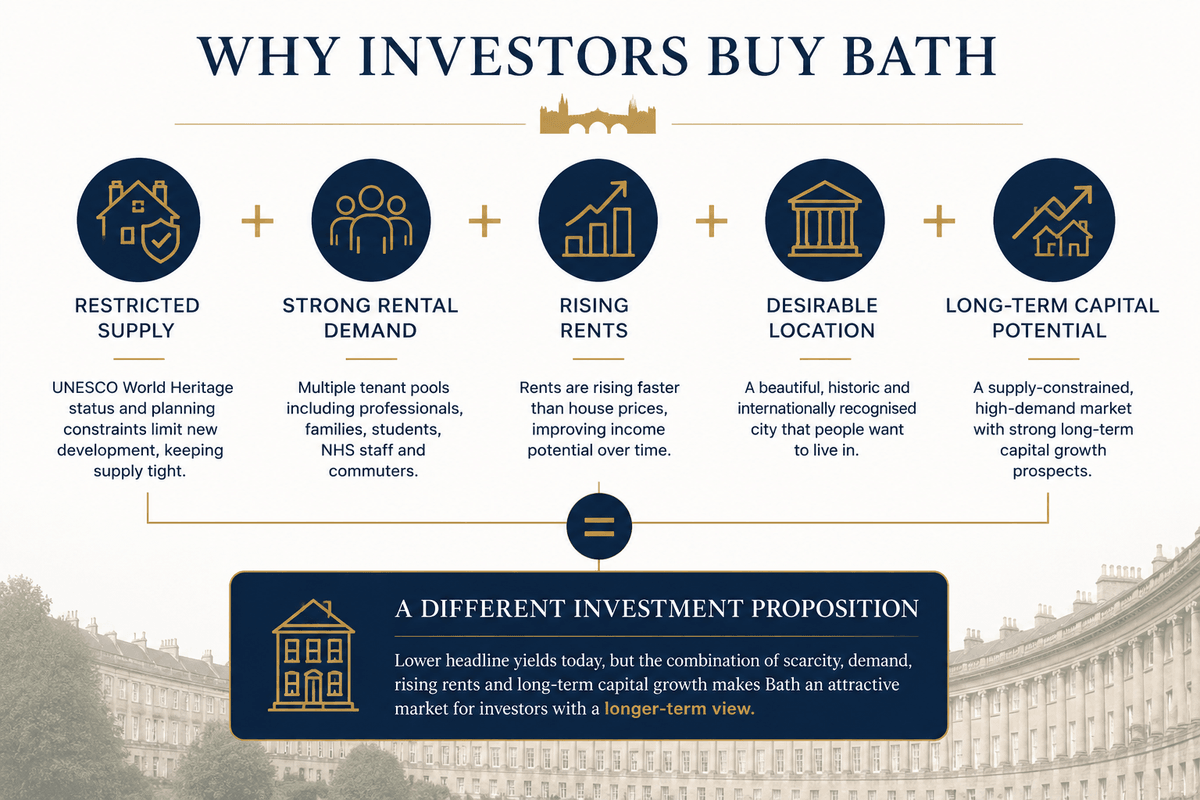
The more I looked into it, the clearer the answer became.
Bath isn't necessarily a market you invest in purely for today's rental yield.
For many investors, the attraction is the combination of rental demand, scarcity, rising rents and the opportunity to hold a desirable asset for the long term.
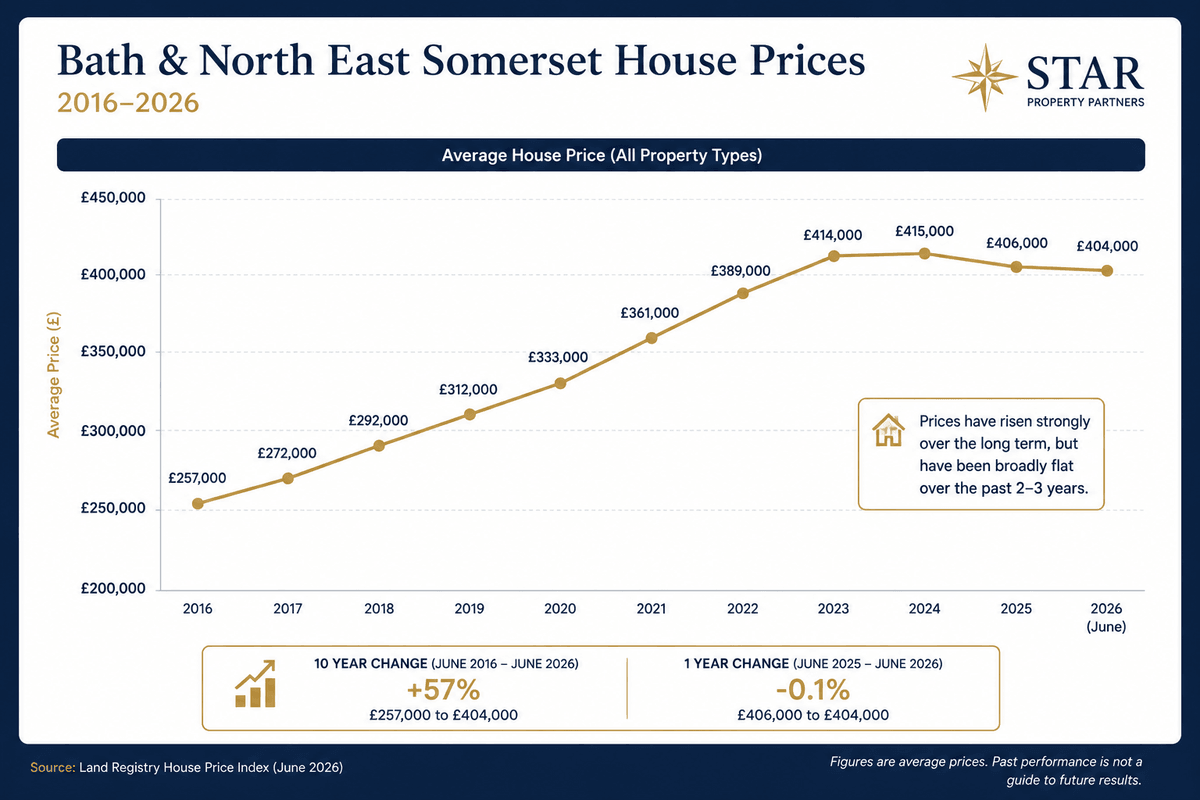
Bath is an expensive place to buy property
There's no getting around this.
According to the Office for National Statistics, the average property price across Bath and North East Somerset was approximately £404,000 in June 2026.
That makes it the second most expensive local authority area in the South West.
For comparison, the South West average was approximately £305,000.
High acquisition prices naturally suppress rental yields.
Recent analysis of the Bath investment market puts typical gross yields at approximately 3.5%–4.4%, depending on location and property type.
That's considerably lower than the yields investors may find in parts of the Midlands or northern England.
So if your investment strategy is simply:
“Where can I achieve the highest possible monthly cash flow?”
Bath may not be the obvious answer.
But yield is only one part of a property investment.
Bath appears to be a capital-value market first
One recent analysis of the Bath property market described it particularly well:
“Bath is a capital-value market before it is an income one.”
That distinction matters.
Some property markets are primarily attractive because relatively inexpensive houses produce high rental yields.
Bath offers something different.
It is an expensive, internationally recognised city where demand for property exists alongside significant restrictions on how much additional housing can realistically be created.
For some investors, therefore, the objective isn't simply to maximise the amount left in the bank account at the end of each month.
It's to acquire and hold a desirable asset in a market where supply is inherently constrained.
The scarcity of Bath property matters
One of the things that makes Bath unusual is that the very characteristics that make it such an attractive place to live also make development difficult.
Bath is a UNESCO World Heritage City — and unusually, it has two World Heritage inscriptions.
Its Georgian architecture, Roman heritage, surrounding landscape and important views across the city are protected.
That inevitably limits development.
Bath & North East Somerset councillor Matthew McCabe described the problem particularly starkly in 2025, saying that building housing at scale in Bath was “nearly impossible” because of the city's heritage and geographical constraints.
From an affordability perspective, that's a serious challenge for the city.
From an investment perspective, however, restricted supply is significant.
Property values are ultimately influenced by supply and demand.
Bath has considerable demand.
But creating substantial amounts of new housing to satisfy that demand is difficult.
You can't simply reproduce Bath.
Meanwhile, rents are rising strongly
This is where the current numbers become particularly interesting.
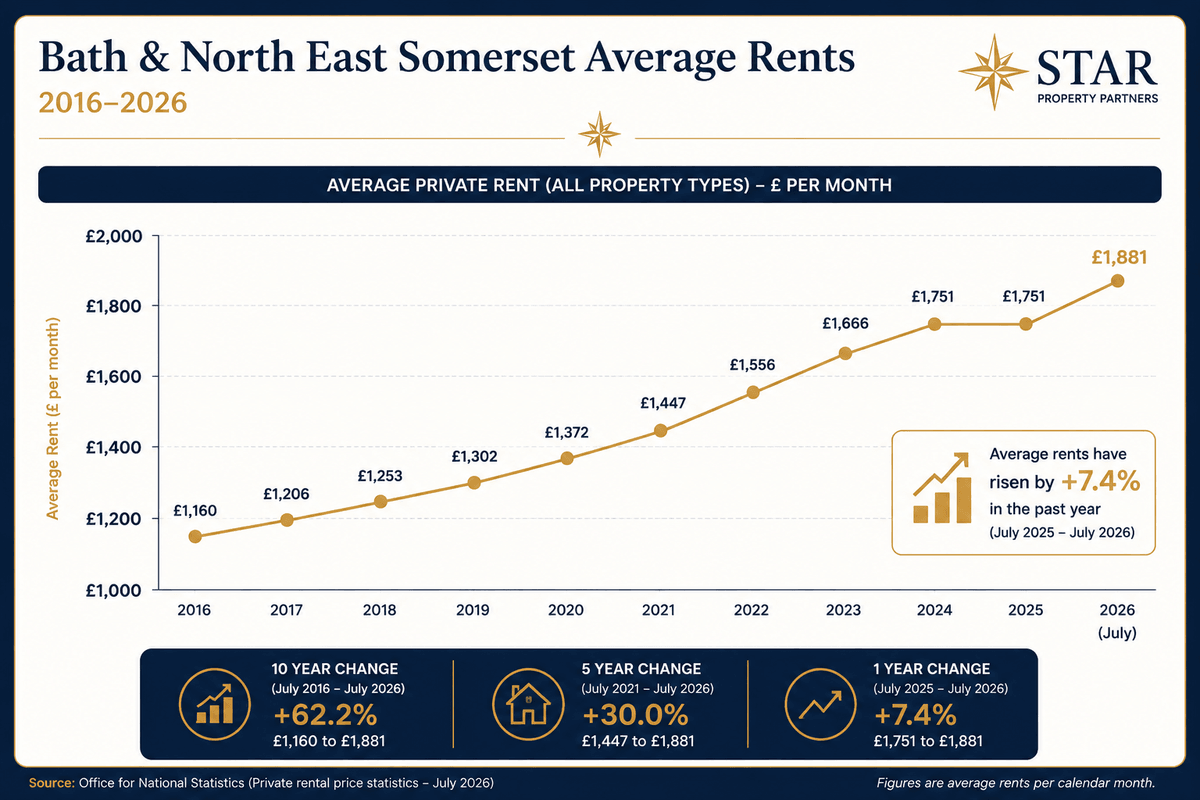
While Bath & North East Somerset house prices have recently been relatively flat, rents have continued to increase.
According to the ONS, average private rent reached:
£1,881 per month in July 2026.
That was up from £1,751 in July 2025.
An annual increase of: 7.4%
For comparison, average rents across the South West increased by 4.5% over the same period.
The increase is even more interesting when looking at some of the property types commonly considered by investors.
Three-bedroom rents increased by 7.9%.
Terraced property rents increased by 7.5%.
The average monthly rents recorded by the ONS in July 2026 were:
Property size Average monthly rent
1 bedroom £1,205
2 bedrooms £1,520
3 bedrooms £1,806
4+ bedrooms £2,531
Of course these are averages across the whole Bath & North East Somerset authority rather than individual Bath streets, so they should never replace property-specific rental comparables.
But the direction of travel is interesting.
Rents are currently growing much faster than property prices.
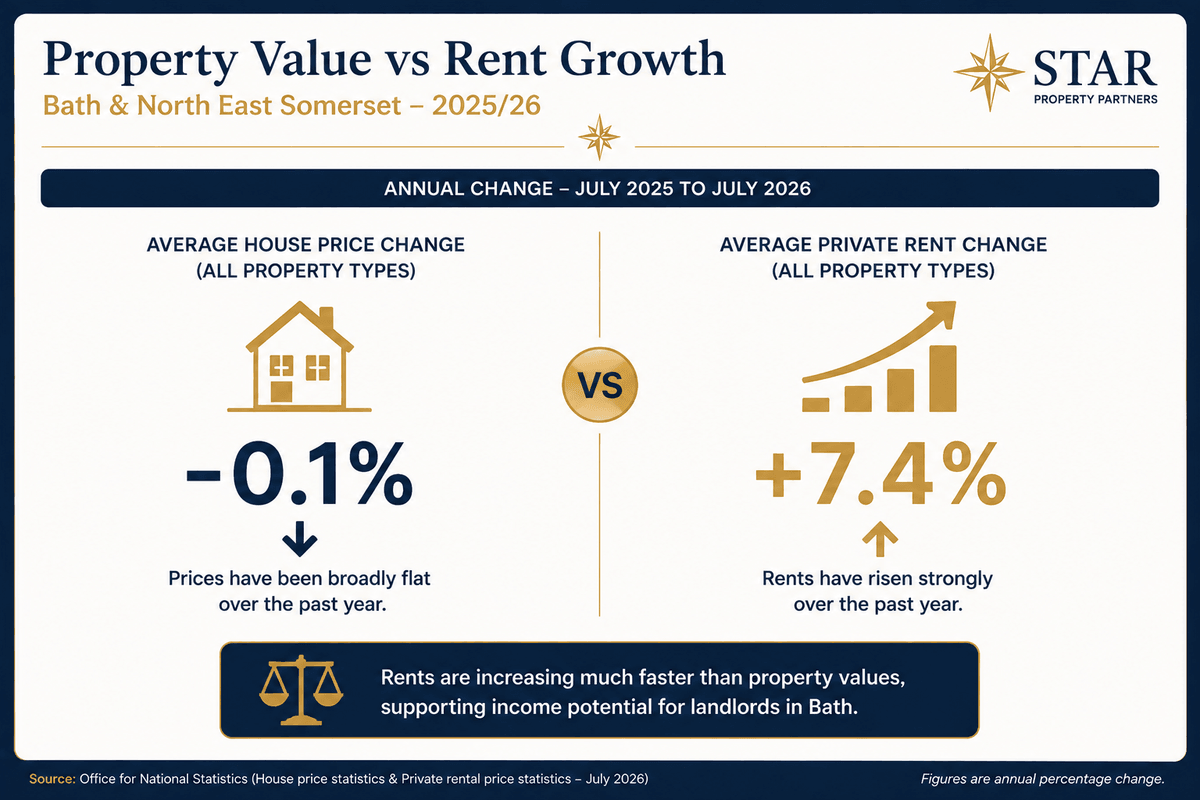
For a long-term landlord, that matters.
A property producing an unremarkable yield today may produce a very different return in five or ten years if rental growth continues while the original purchase price remains fixed.
Bath has several layers of rental demand
Another attraction is that Bath doesn't rely on one particular tenant demographic.
Demand comes from a mixture of:
professionals
- families
- students
- international students
- NHS and healthcare workers
- people working within Bath's tourism and hospitality economy
- people commuting to Bristol
- people relocating from other parts of the UK
- The student population adds another particularly important layer.
Bath is home to both the University of Bath and Bath Spa University.
Recent student accommodation analysis estimated a student population of approximately 46,700, with around 51% requiring accommodation.
That helps explain why HMOs and student accommodation remain such an important part of the Bath investment market.
But even outside the student market, conventional rental demand remains strong.
What about capital growth?
This is probably where the investment case becomes most interesting — and where we need to be careful.
Nobody can reliably predict future house prices.
Past performance doesn't guarantee future growth and property doesn't move upwards in a straight line.
In fact, the latest ONS figures show Bath & North East Somerset prices essentially flat year-on-year.
But property investment is generally a long-term strategy.
Recent Land Registry-based analysis shows average Bath & North East Somerset prices rising from approximately £353,000 to £406,000 over the five years to March 2026 — around 15%.
That doesn't mean the next five years will deliver another 15%.
It does demonstrate why an investor might look beyond today's monthly cash flow.
Consider a purely illustrative £350,000 property.
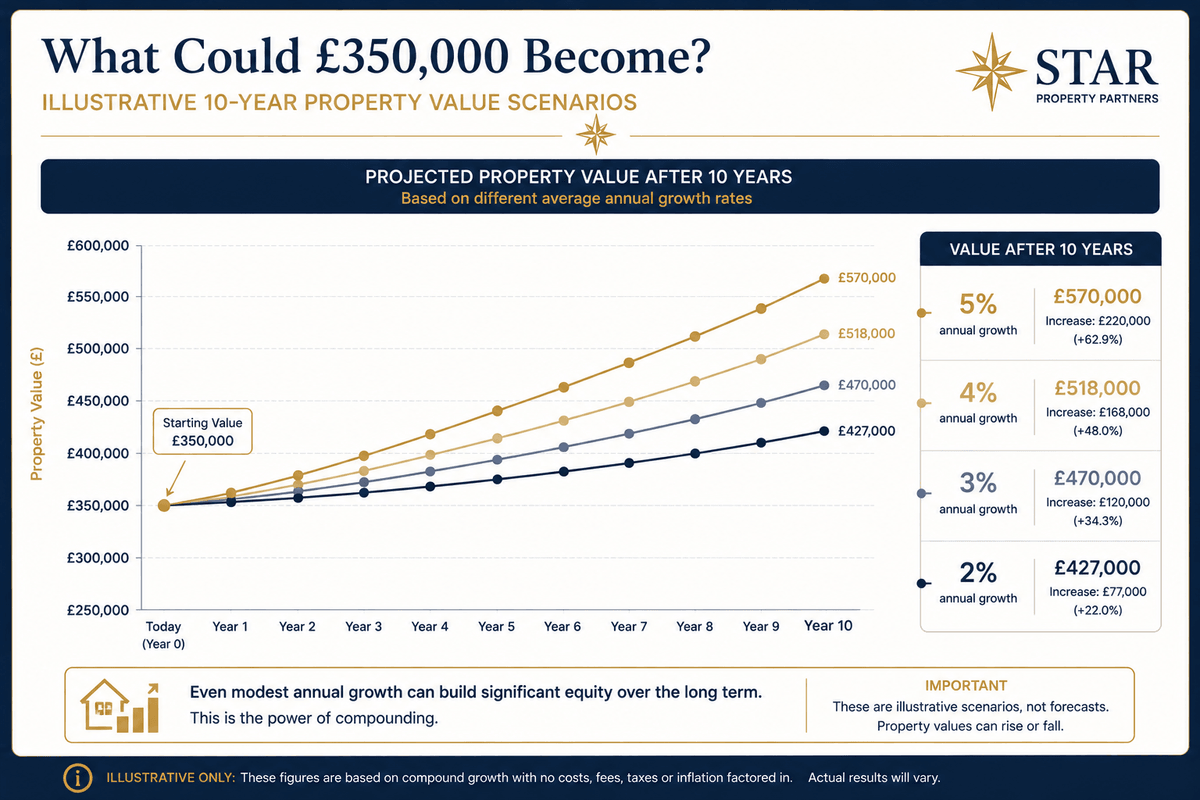
These are scenarios, not forecasts.
But they demonstrate an important principle.
An investor receiving £250 per month in net cash flow may only see £3,000 of immediate annual income.
However, they're also holding a £350,000 asset.
That changes the conversation considerably.
Property investment isn't just about monthly cash flow
This is something I've come to appreciate more as I've analysed Bath deals.
There are several potential components to an investor's return:
1. Rental income
The income remaining after mortgage payments and operating costs.
2. Rental growth
If rents increase over time while the purchase price remains fixed, the income performance of the investment can improve.
3. Mortgage reduction
Where a repayment mortgage is used, part of the tenant-funded rental income may also gradually reduce the investor's debt.
4. Capital appreciation
If the property increases in value over the long term, the investor builds additional equity.
Looked at this way, a property producing £200–£300 per month isn't necessarily producing only £200–£300 worth of value.
But equally, capital growth should never be used to justify buying a bad deal.
The fundamentals still need to work.
This may also explain who is buying
The wider UK market is seeing something interesting.
Despite considerable discussion about landlords leaving the sector, figures reported in May 2026 showed landlords accounting for 13.3% of property purchases across Great Britain between January and April — the highest proportion since 2016.
Much of that activity appears to be landlords buying properties from other landlords.
In other words, we're not simply seeing the disappearance of the private landlord.
We may also be seeing a changing type of landlord.
Smaller or highly leveraged landlords may decide that increasing regulation and costs make property less attractive.
Meanwhile, professional, portfolio and well-capitalised investors may see an opportunity to acquire assets.
That would certainly fit with the conversation I had with the Bath letting agent.
He wasn't seeing investors abandoning Bath.
He was seeing investors buying.
Not every Bath investor wants the same thing
And perhaps this is the most important lesson.
There isn't really such a thing as simply a “good property investment.”
There is a good investment for a particular investor and a particular objective.
Someone seeking maximum monthly cash flow may look at a conventional Bath BTL and decide their capital can work harder elsewhere.
That would be perfectly reasonable.
Someone seeking a long-term asset in a desirable, supply-constrained city may reach a completely different conclusion.
And someone wanting stronger income while retaining exposure to the Bath market may consider an HMO.
The strategy has to match the investor.
Conventional BTL vs HMO in Bath
This is one reason HMOs can be particularly interesting here.
With a conventional buy-to-let, one household is responsible for generating the property's income.
With an HMO, income is generated on a room-by-room basis.
That can fundamentally change the economics.
The acquisition cost is still high.
There are also additional licensing, planning, management, fire-safety and compliance considerations — particularly in Bath where Article 4 planning restrictions need careful consideration.
But the potential income can be significantly higher than an equivalent single-let property.
It potentially allows an investor to combine:
stronger income + exposure to the Bath property market + long-term capital growth potential.
Finding the right property, however, is crucial.
So, is Bath a good place to invest?
The answer is slightly more nuanced than yes or no.
It depends on why you're investing.
If you're looking for the highest possible gross yield in the UK, Bath probably isn't the market for you.
If you're looking for a high-demand rental market, constrained housing supply and a long-term asset in one of Britain's most desirable cities, the argument becomes much stronger.
And if income is important too, the property and strategy need to be selected accordingly.
That's ultimately why I don't believe property sourcing should begin with finding a property.
It should begin with understanding the investor.
What are you trying to achieve?
Income today?
Long-term wealth?
Capital preservation?
Portfolio growth?
A combination of all of them?
Only once we know the answer to that question can we decide whether a particular Bath property represents a good investment.
Because sometimes the best investment isn't the property with the highest yield.
It's the property that best fits what you're trying to achieve.
Sources:
Star Property Partners sources and analyses property investment opportunities in Bath for investors looking for a considered, long-term approach to property. Every opportunity is assessed individually against the investor's objectives rather than relying on headline yields alone.
Property values can rise or fall and past performance is not a guarantee of future returns. Figures and growth scenarios in this article are for illustration and market commentary only and should not be considered financial or investment advice.